Subscribe For Free Updates!

We'll not spam mate! We promise.

Showing posts with label Number. Show all posts

Way to find GCD

Way to find GCD

Way to find GCD - In before post maticschool discuss about how to find greatest common divisor. Now maticschool will proves the second way in before post with problem a larger number.

Way ...

In the second way yesterday we use factor trees to find the gcd. And now maticschool will proves second way in before post with problem a larger number is 100 and 75.

First we determine the two factors with the factor tree.

find gcd, factor tree, factor trees, gcd, use factor tree
 find gcd, factor tree, factor trees, gcd, use factor tree

Factor of :  100 : 22, 52 | 75 : 3, 52 

After we know the factors of both. We find the same factors of both these two factors, from these two factors was the same number 5. Then we find the smallest number whose value from the second number 5. Since both number five of the two factors of equal value is 52 . So gcd 100 and 75 is  52 = 25.

By using the first way that we described yesterday will also find the same answer is 25.

With the first way.

Factor from :

       75 : 1, 3, 5, 15, 25, 75,
       100 : 1, 2, 4, 5, 10, 20, 25, 50, 100

From those two factors there are the same number. 

        75 : 1, 3, 5, 15, 25, 75,
        100 : 1, 2, 4, 5, 10, 20, 25, 50, 100

Numbers 1, 5, 25 is a factor from both numbers are the same but Greates common divisor is the greatest number that can divide two numbers are depleted. SO the result is 25. 

How to fing Greatest Common Divisor

Greatest Common Divisor

Greatest Common Divisor - Greates Common Divisor (GCD), also known as the greatest common factor (gcf) or highest common factor (hcf).

What is Factor ? 
      Factor is a number that can divide other numbers depleted numbers. For more details you can read this example.

         Factors of 20: 1, 2, 4, 5, 10, 20

Numbers 1, 2, 4, 5, 10, and 20 is a factor of 20. Why ? Because of these numbers can divide out the number 20.

What is Greatest Common Divisor ? 
       After we know what that factor ? Then we will understand the meaning of Greatest Common Divisor. Greatest Common Divisor  involve at least 2 numbers. Then what is gcd ? Greates common divisor is the greatest number that can divide two numbers are depleted. For more Details you can further reading this post.

                                                how gcd of 20 and 25 ?

For answer the question above maticschool have some way to answering the questions above.

 Some Way .....
        
1. First way. In this first way we will find the gcd by finding factors of both numbers.

              20 : 1, 2, 4, 5, 10, 20
              25 : 1, 5, 25

Remember ! What is GCD ? Gcd is the greatest number that can divide both numbers are depleted. From a factor of 20 and 25 can be seen that there are several factors that have in common. 

           20 : 1, 2, 4, 5, 10, 20
           25 : 1, 5, 25

From these data it can be seen that the numbers 1 and 5 are both owned by 20 and 25, but Gcd is the greatest number that can divide two numbers are depleted. So from these data it can be concluded that the gcd is 5. However, using such means will be relatively very long to find the gcd of two large numbers.

2. Second Way. The second way we will use the relative does not take much time. In second way we will use factor tree for find the gcd. Still with the same problem we will solve this second way. 


From factor tree can be concluded :
   
     25 : 52 | 20 : 22, 5

From the above results there are two numbers that equal the number 5, but with different values​​. Because there are two numbers are the same, we take the smallest value of the 5 factors of 20. Because it only has 1 factor are the same so that's the answer is 5

for proof of the second way you can click here

Multiplication in Fractions

Multiplication in Fractions

Multiplication in Fractions - Every day we will surely find fractions. Because that we must learn about it And in this post maticschool can discuss through an example.

formula for find multiplication in fractions, multiplication in fractions, formula,

From two example above it can be concluded that the multiplication of fractions not much different integers. 

formula for find multiplication in fractions, multiplication in fractions, formula,

Using Factor Tree in Math

Use Factor Tree in Math  

Factor tree has many functions in mathematics. Besides for find factor the number, factor tree can use for find gcd or lcm in math. And in this discussion maticschool want to discuss how to use the factor tree in math.

Before we use factor tree we must know about primes number. Why ? Because of primes is what will we use for factor tree. To use a factor tree we know of at least between 1-20.

prime numbers between 1-20 = 2, 3, 5, 7, 11, 13, 17, 19

Aftere we know prime numbers between 1-20. Maticschool will give an example with numbers 42.

So from factor tree above the factor of 42 is 2, 3, and 7


Note :
 - In the left position like 2 and 7 is divisor
- Divisor must prime numbers
- In the right position like 21 and 3 is results number
- Factor tree finish if the result number is prime number like in the example is 3

How to Find Least Common Multiple ( LCM )

Least common multiple

Least common multiple - Least common meultiple is a multiple of two or three ( actually four, five and so on was not anything ) numbers are the same and the smallest. As so of the two numbers 2 and 3. Least common multiple form 2 and 3 is 6. And number 6 multiples 2 and 3. Because number 6 multiples 2 and 3 so number 6 can be divided by 3 and 2. 


The Formula ...

There are many ways to find Leas common multiple. 

1. The first way is by adding two numbers with itself continuosly.
   
     2 : 4, 6, 8, 10, 12, 14, ....                                                                                                               3 : 6, 8, 12, 15, 18, 21, .....  
  
        From the example several multiples from 2 and 3 is same. The same numbers is 6 and 12. But in least common multiple just smallest number called least common multiple. But with this way we will use a long time. 

2. The second way is we will use the factor tree. What is factor tree ? factor tree is like this. 


With factor tree we can find the factor with easy. Because that we will use this. 

Example with factor tree. 

 
Factor from 20 and 25. 
    20 : 22, 5  |  15 : 52 

From two factor of 20 and 25, there are the same number is 5. From both the number five we can look 5 from 20 and 52 from 25. Because there are two same numbers we will take the largest. From two 5 number the largest is 52. Then factor from 20 are 22 we will take this for later. So the  two number we take is 52 and 22. From the number we take we will multipliying the two number. 
       
                                      52 × 22 = 25 × 4 = 100
   So the least common multiple from 20 and 25 is 100 


Proving 
     From the second way we can proving about the second way with the first way. The first way is by adding two numbers with itself continuosly. So...

 25 : 25, 50, 75, 100, 125, 150, 175, 200,....
                                           20 : 20, 40, 60, 80, 100, 120, 140, 160, 180, 200,...
            
From two factor above we can look the same number.

                                            25 : 25, 50, 75, 100, 125, 150, 175, 200,....
                                            20 : 20, 40, 60, 80, 100, 120, 140, 160, 180, 200,...

The same number is 100 and 200 but least common cultiple is a multiple of two or three numbers are the same and the smallest. So the smallest is 100. 

So....
    So from the proving above we can conclude that use first way and second way the result is same. And with use the second way is an effective way and does not take a much time.


Division in Fractions

Division in Fractions

Division in Fractions- In before post, maticschool  discuss about multiplication in fractions. And in this post, maticschool  will post about division in fractions. May in division in fractions not to hard like division in integers. Because division in fractions will use multiplication in it.

Formula for Division in Fractions : 

From that formula we can work on the probelm in division in fractions.
For example : 


Keyword for this post : 

division of fractions

division fractions

Privilege Number One in The Division

Privilege Number One in The Division


Privilege Number One in The Division - Division in the mathematic including basic math. Because that we must know about division. Before you read this post, you should read the post about what is division ( you can click here ). Then in the mathematic number one is numbers possessed all the numbers ( except zero ). One is the first number in positive number. Then number one has a special in division. Lets read this post below !

Number one in the division. You can see example in below :

8 : 1 = 8 | 8 : 1 = 8 - 1 - 1 - 1 - 1 - 1 - 1 - 1 - 1 = 0
             | from the example you can calculate how many numbers one ? the numbers one is 8 so from the example we can conclude every number when any number diveded by one the result is a number themselves.

Division Properties ( with Example )

Division Properties


Division Properties - Division icluding basic lesson in mathematic. Because that we must know about it. Before you read this post, you should read about what is division ? For that you can click here. After you know the meaning of division in mathematic, you have to next step about division properties. 

Division Properties : 

a. The Division of Two Integers. 
      Valid for any integer :
         a. ( + ) : ( + ) = ( + )  Example ; 4 : 2 = 2
         b. ( + ) : ( - )  = ( - )  Example ; 4 : ( -2 ) = -2
         c. (  - ) : ( + ) = ( - )  Example ; ( -4 ) : 2 = -2
         d. ( - ) : ( - )  = ( - )   Example ; ( -4 ) : ( -2 ) = 2


b. Division on Integers Is Not Commutative
      Valid for any integers
          a : b ≠ b : a Example 15 : 5 ≠ 5 : 15
                                           5    ≠  1/3       ( not same )

Properties of multiplication in integers


Properties of multiplication

Properties of multiplication - Multiplication in mathematics including basic arithmetic, because that we must know abou it. Before we to next step, you must know about multiplication and integers ( you can click here or here about it ).  After you know about multiplication, You will more easily understand about propersties of multiplication in integers.

Properties of Multiplication : 

a. the result of multiplying two integers can be determined based on the sign of the number.

        1. (+) x (+)  = (+) Example : 2 x 3 = 6
        2. (+) x ( - ) = ( - ) Example : 2 x (-2) = -4
        3. ( - ) x ( - ) = ( - ) Example : ( -2 ) x ( -3 ) = 6

b. The Commutativity of The Multiplication
       For any integer
           a x b = b x a
       Example : 5 x 2 = 10 or
                      2 x 5 = 10   ( the answer is same although the location of the exchanged )

c. The Assosiative of The Multiplication
       For any integer
         ( a x b ) x c = a x ( b x c )
       Example : ( 2 x 3 ) x 4 = 6 x 4   = 24 or
                      2 x ( 3 x 4 ) = 2 x 12 = 24 ( the answer is same althoungh the location of the                                                                                                     exchanged )  

d. Multiplication by Zero
      For multiplication by Zero you can click here

e. Distributive Properties
      1. Distributive properties of the summation
           For any integer
             a x ( b + c ) = ( a x b ) + ( a x c )
                  Example : 2 x ( 2 + 3 ) = ( 2 x 2 ) + ( 2 + 3 )
                                                    =     4       +      6     = 10
   
      2. Distributive properties of the reduction
            For any integers
              a x ( b - c ) =  ( a x b ) - ( a x c )
                 Example : 2 x ( 8 - 3 ) = ( 2 x 8 ) - ( 2 x 3 )
                                                  =     16     -     6      = 10

Pythagorean theorem

Pythagorean theorem

Pythagorean theorem - In the Pythagorean theorem involves number squares, and square roots in a triangle.By using the pythagorean, you can specify the length of one side of a right triangle, given the other two sides.

Formula

ab2 + ac2 = bc2

Example : 

The question : 
what is the length of the bc ? 

The answe : 

ab2 + ac2   = bc2
52   + 122  = ?2 
25 + 144   = ?2
169           = ?2
?                   = 13

Multiplication in Algebra ( part 3 )

Multiplication in Algebra | Difference of Two Squares

algebra, a + b, mathematic, math, algebra mathematic, matematika, aljabar


Multiplication in Algebra - Difference of Two Squares - Still the same as previous aljbar multiplication, this multiplication also still use the distributive properties. Now we will discuss the binomial multiplication of (x + y) and (x - y). Now you see this picture below :

Difference of Two Squares

From the picture we can draw conclusions :
( x + y ) ( x – y )  =  x ( x – y ) + y ( x – y )
                           = ((x . x) – ( x . y)) + ((y . x ) – ( y . y ) )
                           =     x2     – xy  + yx  - y2     =      x2 + y2

Example : 

( 2x + 3y ) ( x - 2y ) = 2x ( x - 2y ) + 3y ( x - 2y )
                                = (( 2x . x) -  ( 2x . 2y )) + (( 3y . x ) - ( 3y . 2y ) )
                                = ( 2x2        - ( 2 . 2 x . y )) + ( 3yx   -  ( 3 . 2 . y . y )
                                = 2x2   - 4xy   +   3yx   - 6y2 
                                = 2x2       - 1xy      - 6y2

Multiplication in Algebra ( part 2 )

Multiplication in Algebra | Binomial multiplication with two tribes

Multiplication in Algebra, algebra, a + b

Multiplication in Algebra - Binomial multiplication with two tribes - 
   Still the same as the previous multiplication. Binomial multiplication with two tribes still use the distributive properties.What is the nature of the distributive ? You can click here for know about distributive. Binomial multiplication with two tribes you can see this picture below :

    From the picture we can draw conclusions :

( a + b ) ( c + d ) = ( a x c ) + ( a x d ) + (b x c ) + ( b x d )

                           =       ac    +     ad       +   bc      +    bd 

   Example : 

( 2x + 3y ) ( x + 2 y ) = ( 2x . x ) + ( 2x . 2y ) + ( 3y . x ) + ( 3y . 2y)
                                  = 2x2    + ( 2 . 2 . x . y ) + 3yx       + ( 3 . 2 . y . y )
                                  = 2x2    +       4xy          + 3xy       + 6y2
                                             = 2x2     +                   6xy              + 6y2 


                                                                                                                                                               next part ( to part 3 )

Multiplication in the Algebra ( part 1 )

Multiplication in the Algebra | 

The Multiplication Rate With Two or More Parts 

x + y =, x + y, algebra, mathematic algebra

Multiplication in the Algebra - The Multiplication Rate With Two or More Parts -
The rate of multiplication algebra we will use as the basis of distributive properties. To know what was the nature of distributive, you can click here.

The Multiplication Rate With Two or More Parts 
        
         We can use the nature of distributive for the multiplication rate with two or more parts. 
    Distributive Properties : 
      a x ( b + c ) = ( a x b ) + ( a x c ) or ( a + b ) x c = ( a x c ) + ( b + c )

    Distributive Properties in the algebra : 
       aX x ( 1X + 1y ) = (aX x 1X ) + ( aX x 1y)
                                  = 1aX2   + 1aXy

         Example :
                a. 1a ( 3a + 4b) = ( 1a x 3a ) + ( 1a x 4b )
                                         = ( 1 x a x 3 x a ) + ( 1 x a x 4 x b )
                                         = ( 1 x 3 x a x a ) + ( 1 x 4 x a x b )
                                         = ( 3 x a2 ) + ( 4 x ab)
                                         =  3a2  + 4ab

                                                                                                                                   next part ( to part 2 )

Operating Properties of Numbers Count

Operating Properties of Numbers Count

numbers, 1 + 1, addition

Operating Properties of Numbers Count - Operating Properties of Numbers Count still very basic in math. Although very basic but very important in mathematics. Without this mathematics will not be as advanced as now. Before we learn more details about mathematics we must know about this.


Operating Propertis of Numbers Count :


1. Commutative properties (exchange)

    a.) the commutativity of the sum is a + b = b + a

    b.) the commutativity of the multiplication is a x b = b x a    

2. Associative properties ( grouping )

     a.) associative nature of the summation is a + ( b + c ) = ( a + b ) + c

     b.) associative nature of the multiplication is a x ( b x c ) = ( a x b ) x c


3. Distributive Properties ( deployment )

     Distributive properties is a x ( b + c ) = ( a x b ) +   ( a x c ) or ( a + b ) + c = (a x c ) + ( b x c )

Basics of Algebra

Basics of Algebra - Maybe some people already know about algebra. But there are also people who do not know about it. In this explanation I will make an example :

Consider the following example :

a. 3x
b. 3x + 5xy
c. 4x + 2 + 3xy + 5

From the following example, we can determine which variables, coefficient, constant, and tribes algebra. In the math sentence above, the coefficient is concatenated variable numbers. So the coefficient is 3 in a. example, and then 3 and 5 in the b. example. And the last in c. example is just 4 and 3. Then just 2 and 5 in c. example, continued without any letters is constant. Next variables is the alphabet that follow the number. So from the example the variables is x, y, and xy.How about tribes algebra ? Look back from the three example above. For a. example called single tribe.

Keyword for this post :

basic algebra

algebra

elementary algebra

Addition or Recudtion in Al-Gebra

Addition or Recudtion in Al-Gebra

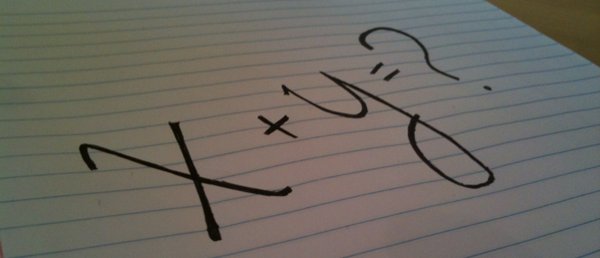
Al-gebra, algebra, x + y, the picture of x+ y
Addition or Recudtion in Al-Gebra - Basically arithmetic operations in algebra no different integer arithmetic operations. Arithmetic operations of addition and subtraction algebra tribe done by adding or subtracting the coefficients between similar tribes. For example you can see the example below :

Answer the following question correctly !

1. 2x + 3x =
2. 4x + 5x =
3. 2x + 2y + 2x =
4. 2x + 1y =
Answer

1. 2x + 3x = 5x
2. 4x + 5x = 9x
3. 2x + 2y + 2x = 2x + 2x + 2y = 4x + 2y
4. 2x + 1y = 2x + 1y = 2x + y
Study :

From the example , in fact  is same. But before answer we must look the variable behing the number.  When the variable is same, numbers can be added or subtracted. But when the variable is not same, numbers can not be added or subtracted. So the result like the example 3th and 4th.

One in Multiplication Properties

one, 1, number one
One in Multiplication Properties - This number represents a single case. One also had the privilege of mathematics. The privilege is not held by another number. For example you can see the following example.

2 x 1 = 2
3 x 1 = 3
4 x 1 = 4


From the example we can draw conclusions, that :

"A" x 1 = 1 x "A" = "A"

From the conclusions can be said every number multiplied by one then the result is the number itself.

Nature of Zeros in the Multiplication

Nature of Zeros in the Multiplication -   Zero is a number that could be considered privileged. Why ? Because if there are no zeros development may not be as advanced as today. And zeros have the privilege of multiplication. Privilege zero in multiplication  is any number multiplied by zero the result will be zero.
For example : 

1 x 0 = 0
2 x 0 = 0
3 x 0 = 0

from these results we can conclude : 
      if "A" is any natural numbers so  
  0 x "A" = "A" x  0 = 0               

Meaning of Multiplication

Meaning of Multiplication - Possible, every day will find multiplication.For example in minimarket, supermarket, store, etc. Multiplication of the four basic arithmetic (division, addition, subtraction, multiplication) including the fundamental. Meaning that multiplication is repeated addition. For more details see the example below :

3 x 2 = 3 + 3 = 6

be written in a sentence is three plus three. Why is the number three is added twice ? bacause the number three multiplied by two, so three plus three equals six. If the number three is multiplied by the number three, so three plus three plus three equals nine.

Some examples of multiplication :

4 x 2 = 4 + 4 = 8
3 x 3 = 3 + 3 + 3 = 9
2 x 4 = 2 + 2 + 2 + 2 =  8

Relationship Between 2 Numbers

number, numbers, one, mora than
Relationship Between 2 Numbers - Between 2 integers which can be compared to the larger, equal to / smaller. Symbols that you can look like this.

a. "A" is greater than "B" written like this "A" > "B"
b. "A" is smaller than "B" written like this "A" < "B"
c. "A" less than or equal to "B" written like this "A"≤"B"
d. "A" greater than or equal to "B" written like this "A" ≥ "B"